

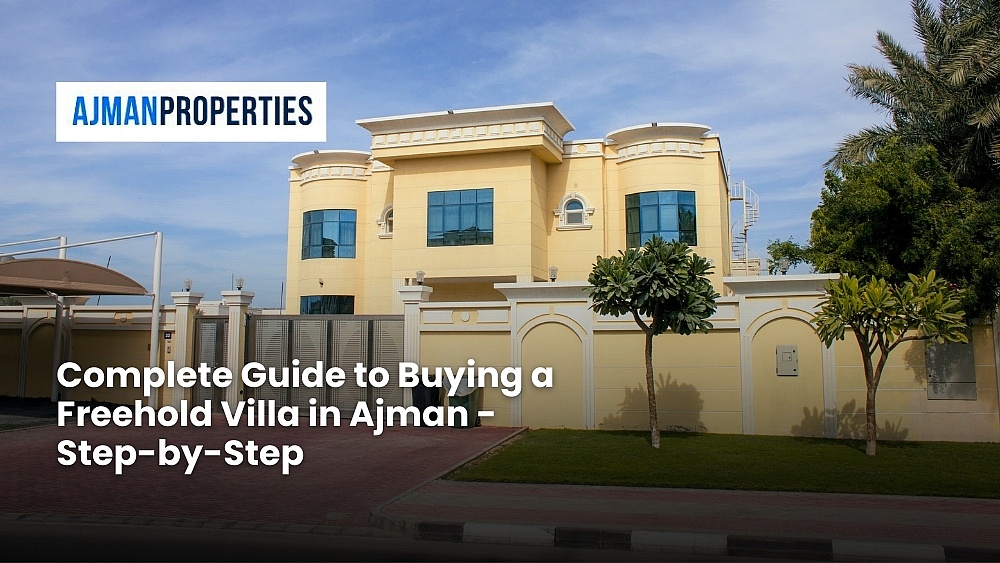
TL; DR
- Buying a freehold villa in Ajman generally takes two to six months from choosing a property to collecting the keys.
- Both UAE nationals and expatriates can own villas outright in Ajman's designated freehold zones, regulated by ARRA.
- Budget for roughly 6-8% above the purchase price to cover registration, title deed, valuation, and mortgage-related fees.
- Ajman's property registration fee is typically 2% of value for UAE/GCC nationals and 3% for other buyers, plus an AED 350 title deed fee.
- Utilities in Ajman are supplied by Etihad Water and Electricity (formerly FEWA), not Dubai's DEWA.
- Mortgage financing is available at up to 80-85% loan-to-value on a first home, with current fixed rates generally in the high-3% to low-4% range.
- A proper Sale and Purchase Agreement, developer NOC, and independent property inspection are non-negotiable steps, however smooth the process feels.
Buying a villa is one of those processes that sounds more intimidating in the abstract than it actually is once you break it into its real steps. Ajman's freehold market has matured enough that the path from "I like this community" to "here are my keys" is genuinely well-trodden; you just need to know what happens at each stage, and which details are worth double-checking rather than assuming.
Most of the genuine mistakes buyers make in Ajman don't come from a lack of information out there they come from doing the steps out of order. Falling in love with a villa before checking your real financing capacity, or signing an agreement before verifying the title, tends to cause far more stress than any individual step in the process itself. Following the sequence below in order is, on its own, most of the advice worth having.
This guide walks through that entire journey in order, with the practical details that actually matter along the way. If you're still weighing freehold against other ownership structures, the Difference between Freehold & Leasehold Villas in the UAE is worth reading first.
Step 1: Decide What You Actually Need Before You Start Looking
It's tempting to start with listings. Resist that for a week and start with numbers and priorities instead it saves a genuinely surprising amount of wasted viewing time later.
Setting a Realistic Budget
Freehold villas across Ajman's established communities generally range from around AED 1.4 million for smaller units to AED 6.5 million or more for larger homes in premium locations, with most family-sized 3- to 4-bedroom villas sitting somewhere between AED 1.4 million and AED 2.5 million. Whatever figure you land on, budget an additional 6-8% on top for registration, title deed, valuation, and mortgage-related fees; the details are covered later in this guide, but that percentage is worth having in mind from day one so it doesn't come as a surprise.
Matching the Community to Your Life, Not Just the Price
Al Yasmeen, Al Zahya, Al Helio, Al Rawda, and Al Mowaihat each offer a genuinely different balance of maturity, price, and property type; some are settled and fully built out, others are still developing but priced accordingly. Rather than picking on price alone, think honestly about your actual daily routine: where you'll work, whether school runs matter, and whether you'd rather move into somewhere finished today or accept some ongoing construction in exchange for a lower price.
Step 2: Understand Freehold Ownership Before You Fall in Love with a Villa
Freehold ownership means owning both the land and the building outright, with full rights to sell, lease, mortgage, or pass the property to heirs, and no time limit attached. Ajman's freehold framework, established under the emirate's Amiri Decrees and regulated by the Ajman Real Estate Regulatory Agency (ARRA), allows UAE and GCC nationals to own property across the emirate, while non-GCC expatriates can buy freehold specifically within designated zones, which is where Ajman's major villa communities sit.
It's worth understanding this distinction before you get emotionally attached to a specific villa: confirm the exact property sits within a genuinely designated freehold zone, since ownership rules can vary even between neighbouring developments.
For expatriates specifically, freehold ownership doesn't automatically come bundled with residency. A UAE residence visa tied to property ownership is a separate process with its own value thresholds, so if long-term residency is part of your motivation for buying, confirm the current requirements directly rather than assuming ownership alone secures your visa status.
Step 3: Inspect and Verify Before You Commit
This is the step that gets rushed most often, usually because buyers are excited and don't want to seem difficult in front of a seller or agent. Push through that instinct; a few hours of careful checking now is considerably cheaper than a dispute or costly repair discovered after you've already signed and paid.
- Physical inspection: walk the villa's structure, finishes, plumbing, and electrical systems yourself, or bring an independent inspector for anything beyond a cosmetic check. This matters just as much for a ready villa as it does for a resale.
- Developer verification: confirm the developer and project are properly registered with ARRA, and that any off-plan phase holds a genuine escrow account under Ajman Law No. 8 of 2007.
- Title deed and ownership history: confirm the property carries a clean title with no unresolved disputes, outstanding mortgages, or ownership ambiguity through official Ajman Land Department records.
- Zoning and compliance: confirm the villa's use matches its zoning classification and that any modifications by previous owners were properly permitted, since unpermitted structural changes can complicate your own registration later.
Step 4: Decide How You're Paying Cash or Mortgage
Both routes are common in Ajman, and neither is inherently the smarter choice it depends on your liquidity, your appetite for a long-term repayment commitment, and how the numbers actually work for you.
|
|
Cash Purchase |
Mortgage |
|
Upfront capital needed |
Full property value plus fees |
Deposit (typically 15-40% depending on buyer type) plus fees |
|
Speed to close |
Generally faster, fewer approval steps |
Adds valuation and bank approval time |
|
Ongoing commitment |
None |
Monthly repayments over 5-25 years |
|
Best suited to |
Buyers with available liquidity who want a clean, fast purchase |
Buyers who'd rather preserve capital or can't cover the full price outright |
If you're financing, mortgages for a first home in Ajman are typically available at up to 80% loan-to-value for expatriates and 85% for UAE nationals on properties under AED 5 million; meaningfully lower, around 60-65%, for a second or investment property. Current fixed rates generally sit in the high-3% to low-4% range for the first few years, though this moves with the market, so get a real quote rather than anchoring to any figure in this or any other article. Getting pre-approved before you make an offer, not after, tells you your genuine budget and puts you in a stronger negotiating position.
Step 5: Get the Legal Documents Right
Once you've chosen the villa and settled how you're paying, the paperwork stage begins in earnest. The Sale and Purchase Agreement (SPA) is the core document it sets out the price, payment schedule, handover timeline, and each party's obligations, and it's worth reading in full rather than skimming to the signature page. A No Objection Certificate (NOC) from the developer confirms there are no outstanding dues or legal issues blocking transfer and is generally required before registration can proceed.
If you're buying from overseas or simply can't attend every step in person, a Power of Attorney lets a trusted representative sign on your behalf common among international buyers, but worth having properly notarised and scoped to exactly what you want authorised, nothing broader. For any purchase above a modest value, independent legal review of the SPA is a sensible cost, not an unnecessary one.
Pay particular attention to the SPA's clauses on delay penalties, what happens if either party withdraws, and exactly what's included in the sale. Fixtures, appliances, and finishes are sometimes assumed rather than explicitly listed, which becomes a genuine point of dispute at handover if it isn't nailed down in writing beforehand.
Step 6: The Payment Process, Stage by Stage
- Down payment: typically 10-20% of the price, paid on signing the SPA or considerably more if the purchase is an investment property financed at a lower LTV.
- Instalments (for off-plan): spread across the construction period according to the developer's payment plan, often tied to construction milestones.
- Bank disbursement (if financing): your lender releases funds according to the agreed schedule, whether that's a lump sum for a ready villa or milestone-based payments for off-plan.
- Final payment: due on or near handover, before ownership formally transfers.
Keep every receipt, wire transfer confirmation, and signed document throughout this process, ideally in one folder rather than scattered across emails it's a small habit that saves real stress if any payment or timeline is ever disputed later.
Step 7: Registration, Fees, and the Title Deed
Ownership transfer is finalised at the Ajman Land Department, where the property is registered in your name, and you receive your title deed. The main costs at this stage are the property registration fee, typically 2% of the property's value for UAE and GCC nationals, and around 3% for other buyers, and the title deed issuance fee, a modest flat charge commonly cited around AED 350. A separate developer NOC fee may also apply, set by the developer rather than the government, and required before the transfer can be finalised.
Once these fees are settled and the deed is issued in your name, you hold full, legally registered ownership at the point at which the villa genuinely becomes yours in the eyes of the law, not just in the eyes of the seller.
Step 8: Utility Connections and Moving In
One detail that trips up a surprising number of buyers, including some relocating from Dubai: Ajman's electricity and water are supplied by Etihad Water and Electricity (EWE), formerly known as FEWA, not Dubai's DEWA. Connection is generally quick, often approved within a day or two once you submit your documents and title deed with a refundable security deposit typically in the region of AED 1,500 to AED 2,000 or more for a villa, depending on size.
Internet and phone services come from Etisalat or du, with installation typically taking a few days once requested. Before you fully move in, do a proper handover inspection test of every fixture, appliance, and system the developer or seller claimed was included, and note anything not working before you sign off, since it's considerably harder to resolve after handover than before.
The Hidden Costs Buyers Often Overlook
|
Cost |
Typical Amount |
|
Property registration fee |
2% of value (UAE/GCC nationals), 3% (other buyers) |
|
Title deed issuance fee |
Approx. AED 350 |
|
Developer NOC fee |
Set by developer, varies by project |
|
Mortgage processing fee (if financing) |
Approx. 1% of loan amount |
|
Property valuation fee |
Approx. AED 2,500 – 3,500 |
|
Utility connection deposit |
Approx. AED 1,500 – 2,000+ for a villa |
|
Annual service charges |
Varies by community and amenities |
These figures are typical ranges rather than fixed amounts and can shift with policy updates. Always confirm current fees with the Ajman Land Department or your bank before finalising your budget.
Common Mistakes First-Time Buyers Make
- Skipping independent verification of the title deed, trusting the seller's word instead of checking official Ajman Land Department records directly.
- Underestimating the 6-8% in additional fees and arriving at registration short of cash.
- Signing the SPA before securing mortgage pre-approval, then discovering the financing doesn't stretch as far as assumed.
- Assuming DEWA covers Ajman and being caught off guard when utility setup follows a completely different process through Etihad Water and Electricity.
- Rushing the physical inspection to avoid seeming difficult, then discovering issues only after handover, when they're far harder to resolve.
Tips for a Smooth, Successful Purchase
- Check the developer's delivery history, not just their current marketing, particularly for off-plan purchases.
- Ask about planned infrastructure nearby, since ongoing construction can affect both daily life and future resale value.
- Work with a licensed real estate agent and, for anything beyond a straightforward purchase, an independent lawyer familiar with Ajman's freehold rules.
- Keep every agreement, receipt, and message in one organised file from day one, not assembled retroactively when a question comes up.
- Understand community service charges and any HOA-style obligations before you buy, not after your first annual bill arrives.
Related Guides
For more detail on the topics covered in this guide, these AjmanProperties.ae resources are natural next reads:
- Difference between Freehold & Leasehold Villas in the UAE: the ownership distinction covered briefly in Step 2.
- What Fees You Must Pay While Buying Property In Ajman? A fuller breakdown of registration and transaction costs.
- Ajman Freehold Properties 2025: Best Areas, Price Trends & Buyer's Guide: pricing context for Step 1's budget planning.
- Thinking Of Buying a Villa in Ajman? Here's What You Need To Know: a broader introduction for first-time buyers.
- The Most Popular Freehold Villa Communities in Ajman helps narrow down Step 1's community choice.
- Living in Ajman: Here is Everything to Know: useful background if you're still deciding whether Ajman is right for you.
Frequently Asked Questions
Can foreigners buy freehold villas in Ajman?
Yes. Non-GCC expatriates can own freehold property outright within Ajman's designated freehold zones, with full rights to sell, lease, or mortgage the property.
How much does it cost to register a villa purchase in Ajman?
The property registration fee is typically 2% of the property's value for UAE and GCC nationals, and around 3% for other buyers, plus a modest title deed issuance fee of roughly AED 350.
How long does the buying process take from offer to keys?
Generally two to six months for a ready villa, depending on mortgage approval speed, document readiness, and how quickly registration is completed. Off-plan purchases follow the developer's own construction and handover timeline instead.
Do I need a lawyer to buy a villa in Ajman?
It isn't legally required for most straightforward purchases, but independent legal review of the Sale and Purchase Agreement is a sensible precaution, particularly for first-time buyers or higher-value transactions.
What's the difference between a cash purchase and a mortgage purchase?
A cash purchase requires the full property value upfront but closes faster with fewer approval steps; a mortgage requires a smaller upfront deposit but adds valuation, bank approval, and years of monthly repayments.
What is a title deed and how do I get one?
A title deed is the official document confirming your legal ownership of the property, issued by the Ajman Land Department once registration is complete and all applicable fees are paid.
Can I buy a villa in Ajman remotely using a Power of Attorney?
Yes. A properly notarised Power of Attorney allows a trusted representative to sign documents and complete steps on your behalf, which is common among international buyers who can't be present for every stage.
What happens if the property doesn't pass inspection?
Depending on the issue and the terms of your agreement, you may be able to negotiate repairs, a price adjustment, or, in some cases, withdraw from the purchase, which is exactly why inspection should happen before the SPA is finalised, not after.
How do I set up electricity and water in my new villa?
Ajman utilities are supplied by Etihad Water and Electricity (formerly FEWA), not Dubai's DEWA. Applications are typically processed within a day or two online, subject to a refundable security deposit.
What is a developer NOC and why do I need it?
A No Objection Certificate from the developer confirms there are no outstanding dues or legal issues on the property, and is generally required before ownership can be officially transferred and registered.
Is a deposit required before signing the SPA?
Typically, yes, a reservation deposit is common before the full Sale and Purchase Agreement is signed, with the formal down payment (commonly 10-20%) due at SPA signing itself.
What ongoing costs should I expect after buying?
Beyond the mortgage payment if financing, expect annual community service charges, utility bills, and routine maintenance, all of which vary by community and property size, so it's worth asking for current figures before you buy.
Final Thoughts
Buying a freehold villa in Ajman is a genuinely manageable process once you see it as a sequence of specific steps rather than one large, intimidating transaction. Set a realistic budget, understand what freehold ownership actually gives you, verify everything rather than assuming, and get your financing sorted before you fall in love with a specific villa. Buyers who follow that order tend to end up with a smooth purchase and a property that fits their life, not just their first impression of a well-staged viewing.
For more information, explore the latest villas for sale, area guides, market insights, off-plan projects, and expert real estate resources by visiting www.ajmanproperties.ae




Comments (0)
Leave a comment